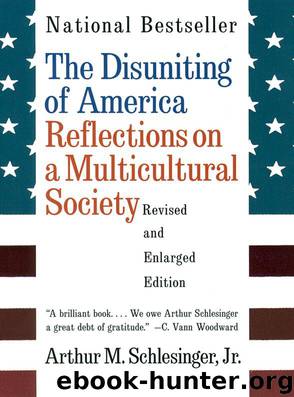
The Disuniting of America: Reflections on a Multicultural Society (Revised and Enlarged Edition) by Arthur Meier Schlesinger
Author:Arthur Meier Schlesinger [Schlesinger, Arthur Meier]
Language: eng
Format: azw3
Publisher: W. W. Norton & Company
Published: 1998-09-17T04:00:00+00:00
IV
“The era that began with the dream of integration,” Richard Rodriguez has observed, “ended up with scorn for assimilation.” Instead of casting off the foreign skin, as John Quincy Adams had stipulated, never to resume it, the fashion is to resume the foreign skin as conspicuously as can be. The cult of ethnicity has reversed the movement of American history, producing a nation of minorities—or at least of minority spokesmen—less interested in joining with the majority in common endeavor than in declaring their alienation from an oppressive, white, patriarchal, racist, sexist, classist society. The ethnic ideology inculcates the illusion that membership in one or another ethnic group is the basic American experience.
Most Americans, however, continue to see themselves primarily as individuals and only secondarily and trivially as adherents of a group. Nor is harm done when ethnic groups display pride in their historic past or in their contributions to the American present. But the division of society into fixed ethnicities nourishes a culture of victimization and a contagion of inflammable sensitivities. And when a vocal and visible minority pledges primary allegiance to the group, whether ethnic, sexual, religious, or, in rare cases (communist, fascist), political, it presents a threat to the brittle bonds of national identity that hold this diverse and fractious society together.
A peculiarly ugly mood seems to have settled over the one arena where freedom of inquiry and expression should be most unconstrained and civility most respected—our colleges and universities. It is not fun running a university these days. Undergraduates can be wanton and cruel in their exclusion, their harassment, their heavy pranks, their wounding invective. Minority students, for the most understandable reasons, are often vulnerable and frightened. Racial cracks, slurs, insults, vilification pose difficult problems. Thus posters appear around the campus at the University of Michigan parodying the slogan of the United Negro College Fund: A MIND IS A TERRIBLE THING TO WASTE—ESPECIALLY ON A NIGGER. Decent white students join the protest against white bullies and thugs.
Presidents and deans begin to ask themselves, which is more important—protecting free speech or preventing racial persecution? The Constitution, Justice Holmes said, embodies “the principle of free thought—not free thought for those who agree with us but freedom for the thought that we hate.” But suppose the thought we hate undercuts the Constitution’s ideal of equal justice under law? Does not the First Amendment protect equality as well as liberty? how to draw a bright line between speech and behavior?
One has a certain sympathy for besieged administrators who, trying to do their best to help minority students, adopt regulations to restrict racist and sexist speech. More than a hundred institutions, according to the American Civil Liberties Union, had done so by February 1991. One can even understand why administrators, not sure what best to do for minorities and eager to keep things quiet, accept—even subsidize—separatist remedies urged by student militants. They might, however, ponder Kenneth Clark’s comment: “The white liberal … who concedes black separatism so hastily and benevolently must look to his own reasons, not the least of them perhaps an exquisite relief.
Download
This site does not store any files on its server. We only index and link to content provided by other sites. Please contact the content providers to delete copyright contents if any and email us, we'll remove relevant links or contents immediately.
| Anthropology | Archaeology |
| Philosophy | Politics & Government |
| Social Sciences | Sociology |
| Women's Studies |
Cecilia; Or, Memoirs of an Heiress — Volume 1 by Fanny Burney(32562)
The Great Music City by Andrea Baker(32023)
Cecilia; Or, Memoirs of an Heiress — Volume 2 by Fanny Burney(31959)
Cecilia; Or, Memoirs of an Heiress — Volume 3 by Fanny Burney(31945)
We're Going to Need More Wine by Gabrielle Union(19053)
All the Missing Girls by Megan Miranda(16051)
Pimp by Iceberg Slim(14522)
For the Love of Europe by Rick Steves(14174)
Bombshells: Glamour Girls of a Lifetime by Sullivan Steve(14081)
Norse Mythology by Gaiman Neil(13376)
Talking to Strangers by Malcolm Gladwell(13376)
Fifty Shades Freed by E L James(13247)
Mindhunter: Inside the FBI's Elite Serial Crime Unit by John E. Douglas & Mark Olshaker(9348)
Crazy Rich Asians by Kevin Kwan(9297)
The Lost Art of Listening by Michael P. Nichols(7509)
Enlightenment Now: The Case for Reason, Science, Humanism, and Progress by Steven Pinker(7316)
The Four Agreements by Don Miguel Ruiz(6770)
Bad Blood by John Carreyrou(6626)
Weapons of Math Destruction by Cathy O'Neil(6284)
